
Q: What unique aerodynamic challenges does textile lint ("fluff") present in a ventilation system?
A: Unlike granular dust, textile lint is fibrous and hygroscopic. These fibers exhibit mechanical interlocking, or "nesting," which allows them to form dense mats. In a pneumatic system, these mats increase internal friction and drastically reduce the effective cross-sectional area of the duct, leading to a rapid rise in static pressure.
Q: What is the recommended Minimum Transport Velocity (MTV) for lint extraction?
A: To keep fibrous material entrained in the airstream and prevent saltation (settling), systems should be designed for an MTV between 2,500 and 3,500 fpm. If the velocity drops below this threshold, material will accumulate in "dead zones," eventually causing a total system blockage. (Note: Minimum Transport Velocity (MTV) varies by material density. Light fibrous materials (lint) may require only 2,500 fpm, while heavy industrial dusts often require 3,500–4,500 fpm. Always calculate based on your specific material.)
Q: How does ductwork leakage impact the energy consumption of the fan?
A: According to ASHRAE 90.1 (Section 6.4.4), duct integrity is critical for energy conservation. Leakage bleeds airflow volume (‘Q’), which reduces velocity (‘V’) downstream. To maintain transport velocity in a leaking system, the fan speed must be increased. Because power (‘P’) is proportional to the cube of the fan speed (P ∝ n3), even a minor increase in speed to compensate for leaks results in a significant energy penalty.
Q: Why are "snag points" a primary concern in textile ducting design?
A: Lint fibers easily catch on any internal protrusions, such as sheet metal screws, rivets, or the "lips" created by misaligned flanged joints. Once a few fibers snag, they act as an anchor for more material, creating a "bolus" that eventually chokes the airflow. Modular systems like Quick-Fit® eliminate these risks by using laser-welded seams and rolled-edge connections for perfect concentric alignment.
Q: What role does ductwork play in NFPA 660 compliance?
A: Textile lint is a combustible dust. Clogs within the ductwork represent a concentrated fuel source and a significant fire hazard. NFPA 660 requires regular internal inspections. Modular ducting facilitates this by allowing tool-free disassembly for rapid cleaning and inspection, whereas traditional welded or flanged systems often require destructive access or significant downtime.
Q: Why is the "bigger is better" approach to duct sizing a mistake for lint systems?
A: Increasing the duct diameter (‘A’) without a corresponding increase in CFM (‘Q’) will cause the velocity (‘V’) to drop (‘V = Q/A’). If this drop pushes the velocity below the MTV, the system will settle and clog regardless of the fan’s horsepower. Proper sizing is a balance between minimizing friction and maintaining the kinetic energy required for transport.
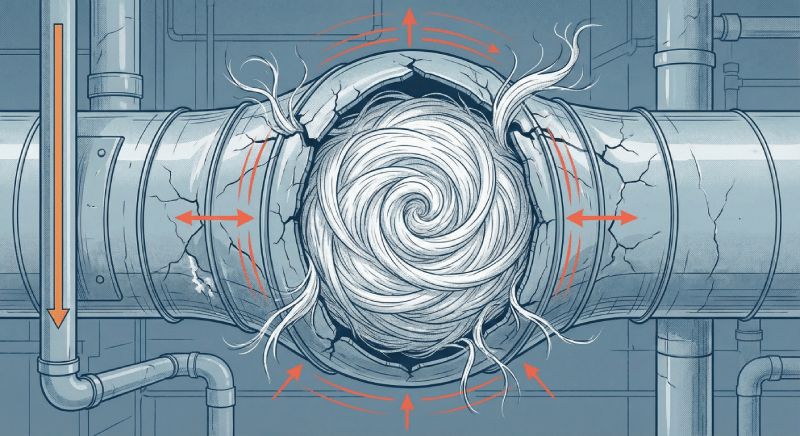
In industrial ventilation, textile lint (commonly referred to as "fluff") represents one of the most significant challenges to pneumatic conveying efficiency. Unlike granular particulate or metal shavings, lint is a fibrous, hygroscopic material characterized by mechanical interlocking. When these fibers enter a ventilation system, they do not behave as discrete particles; they behave as a cohesive network.
For mechanical engineers and facility managers, managing the "Fluff Factor" is a matter of balancing ductwork integrity, transport velocity, and energy consumption. This article provides a technical framework for optimizing lint extraction systems to meet ASHRAE 90.1 (Section 6.4.4) energy requirements and NFPA 660 safety standards.
The primary goal of any lint extraction system is to keep the material entrained in the airstream until it reaches the primary collector. Failure to do so leads to "saltation," where fibers settle out of the air, and "nesting," where they interlock to form dense clogs.
The Minimum Transport Velocity (MTV) is the threshold air speed required to prevent particles from settling. For textile lint, the MTV typically ranges from 2,500 to 3,500 feet per minute (fpm), although heavier or damp fibers may require 3,500+ fpm.
If the velocity falls below this range, the fibers settle in the "dead zones" of the duct. Because lint is elongated, it creates high-friction mats that restrict the effective cross-sectional area of the pipe. As the area (‘A’) decreases, the static pressure (‘SP’) required to move the same volume of air (‘Q’) increases exponentially.
To maintain the MTV, the fan must overcome the cumulative resistance of the system. This resistance is governed by the relationship:
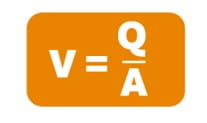
Where:
Any reduction in ‘Q’ (due to leaks) or increase in resistance (due to clogs) destabilizes this equation, often forcing the system into a state of aerodynamic stall.
Energy efficiency in industrial ventilation is often viewed through the lens of fan selection, but the ductwork interface is where the most significant losses occur.
ASHRAE 90.1 (Section 6.4.4) mandates strict sealing requirements. In a lint system, a leak is not merely a loss of conditioned air; it is a "velocity bleed." When air escapes through a joint or seam, the volume of air (‘Q’) remaining in the duct downstream decreases. This causes a proportional drop in ‘V’.
When ‘V’ drops below the MTV, clogs begin to form. To resolve this, facility managers often increase the fan speed via a Variable Frequency Drive (VFD). However, according to the Fan Laws, the power requirement (‘P’) increases by the cube of the speed ratio:
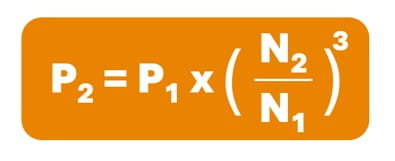
A 10% increase in fan speed to overcome leakage and clogs results in a nearly 33% increase in energy consumption. This is the “sticker shock” of incorrect or inefficient systems.
The method of joining duct segments is the primary determinant of system smoothness and sealing efficacy. In textile applications, the interior surface of the duct is as critical as the fan's horsepower.
Traditional spiral or longitudinal seam ducting often relies on sheet metal screws or rivets for assembly. These fasteners protrude into the airstream, creating "snag points." Because lint is fibrous, a single protruding screw can catch a few strands; these strands then catch more, quickly building a "bolus" of material that obstructs the pipe.
Furthermore, traditional flanged joints often suffer from internal misalignments. If two pipes are not perfectly concentric, a "lip" is created. This lip disrupts the boundary layer of the airflow, causing turbulence and providing an anchor for lint nesting.
Modular clamp-together ducting, specifically the Quick-Fit® system, addresses these challenges through specific design features:
Textile lint is classified as a combustible dust. Under NFPA 660, facilities must mitigate the risk of dust explosions and fires.
A clog in a duct is a localized high-density fuel source. If a spark enters the system, a clogged duct can transition from a ventilation component to a fuse for a secondary explosion. Maintaining a smooth-walled, high-velocity system ensures the fuel load remains at negligible levels.
NFPA 660 requires regular internal inspections. Modular ducting allows for "tool-free" access; a section can be unclamped, inspected, and re-clamped in minutes, ensuring safety inspections are conducted with the frequency required by law.
In textile ventilation, intuitive assumptions often lead to systemic failure. (click here: Debunking Textile Ventilation Myths)
|
Misconception |
Engineering Reality |
|
"Bigger duct is better." |
Oversizing a duct reduces air velocity (‘V = Q/A’). If velocity falls below the MTV, the duct will clog regardless of fan power. |
|
"Taping leaks is sufficient." |
Pressure-sensitive tapes degrade under thermal stress. Mechanical seals are required for industrial durability and ASHRAE compliance. |
|
"Increased fan speed solves all clogs." |
Increasing speed increases energy costs and can cause "blinding" (clogging) of the primary filter media. |
A high-performance lint extraction system requires professional balancing and specific component geometry.
The "Fluff Factor" is an engineering reality that cannot be ignored. By prioritizing ductwork integrity and internal smoothness, engineers can design systems that are energy efficient (ASHRAE 90.1), safety compliant (NFPA 660), and operationally reliable. Precision-engineered modular ducting represents a shift from commodity ventilation to strategic infrastructure, providing a measurable ROI through reduced energy bills and increased system uptime.