10 Critical Questions for Engineering Efficient Ventilation Systems
In industrial facility design, the ducting network is the critical "vascular system" connecting extraction sources to filtration units. While engineers often focus on baghouse specifications and fan curves, the ducting selection determines the system’s total static pressure, energy efficiency, and long-term operational costs.
Poor ducting choices, such as undersized gauges or inefficient connection methods, lead to increased energy consumption, non-compliance with NFPA combustible dust standards, and excessive maintenance labor.
To validate a ventilation strategy, engineers must answer ten critical questions regarding material science, fluid dynamics, and installation logistics.
1. Material Selection: What are the physical and chemical characteristics of the airstream?
The duct material and gauge must be matched specifically to the abrasiveness, corrosivity, and moisture content of the particulate.
Generic "dust" definitions are insufficient for engineering specifications. The longevity of the ducting depends on granular material data:
- Abrasion Resistance: High-velocity transport of silica, glass, or heavy wood chips acts as a sandblaster on duct interiors. Standard HVAC-gauge metal will fail rapidly. Heavy-gauge galvanized steel is required for these abrasive applications to prevent premature wear at elbows.
- Chemical Resistance: Acidic fumes or caustic wash-down environments require material stability. Stainless Steel (304 or 316) is the engineering standard for resisting corrosion in these environments.
- Moisture Management: Hygroscopic dusts require smooth internal surfaces to prevent caking. Rough welds or raw edges in standard piping serve as anchor points for buildup, restricting airflow.
2. Airflow Performance: How does the connection method impact static pressure?
Clamp-together ducting systems significantly reduce static pressure loss compared to flanged or screw-connected systems.
Minimizing static pressure loss is the primary goal of efficient duct design. Friction loss occurs at every joint, elbow, and seam.
- The Problem with Traditional Connections: Flanged connections often suffer from misalignment, creating internal "steps." Screw-connected piping introduces metal screws directly into the airstream, causing turbulence and snagging fibrous materials.
- The Modular Solution: Systems like Nordfab Quick-Fit® utilize a rolled lip and gasketed clamp connection. This aligns the duct ends perfectly, creating a smooth, obstruction-free interior.
- Energy Impact: The collector is designed to operate at a specific air speed and pressure so if your ducting causes too much turbulence, or is too leaky, the system will not operate properly and cause issues during final inspection. Lower resistance (static pressure) allows the system fan to operate at a lower RPM via a Variable Frequency Drive (VFD), directly reducing electrical consumption.
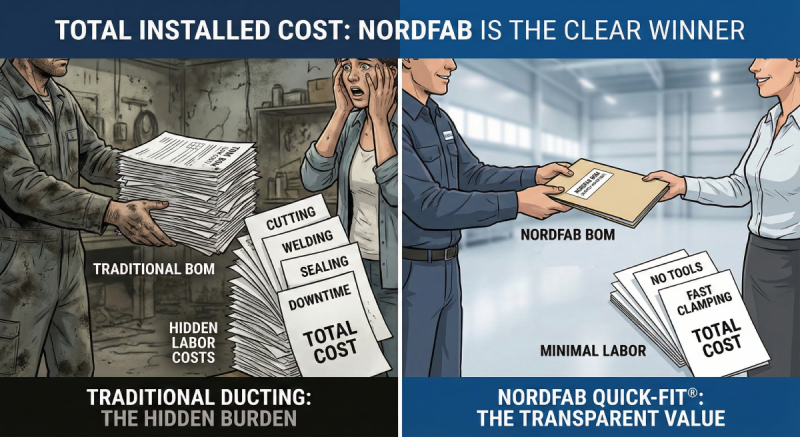
3. Total Cost of Ownership: What is the total installed cost (Material + Labor)?
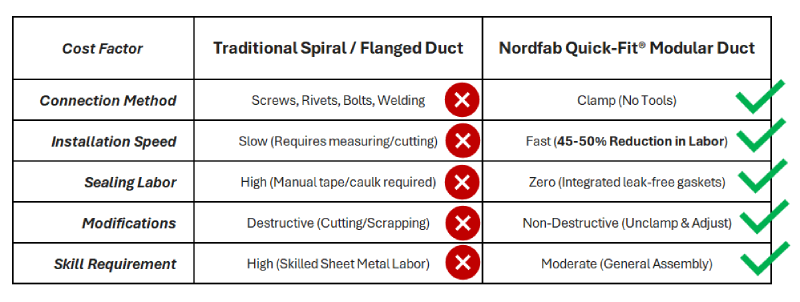
While the bill of materials (BOM) for modular ducting may be higher, the total installed cost is often 30-50% lower due to reduced labor hours.
Engineers must calculate the "Installed Cost," not just the purchase price. Traditional spiral pipe requires cutting, drilling, riveting, and sealing, both labor-intensive processes that require skilled trades.
Comparative Analysis: Spiral vs. Modular Ducting
4. Future-Proofing: How adaptable is the system to process changes?
Modular ducting systems support Lean Manufacturing by allowing immediate, non-destructive reconfiguration of machinery.
Manufacturing floors are dynamic; production cells move and capacities expand.
- Rigid Systems (Welded/Flanged): Moving a machine requires cutting and scrapping existing ductwork. This is a capital loss and a time sink.
- Adaptable Systems (Clamp-Together): Nordfab Quick-Fit® is 100% reusable. If a machine is relocated, the ducting can be unclamped, telescoping sections adjusted, and re-installed in minutes. This turns the ducting into a long-term asset rather than a consumable construction material.
5. Safety Compliance: Does the system meet NFPA standards for combustible dust?
Ducting must provide electrical continuity and support spark detection to comply with NFPA 660 (Standard for Combustible Dusts).
For facilities handling combustible dusts (wood, metals, sugar, plastics), static electricity is a recognized ignition source.
- Conductivity: Metal ducting must ensure continuity across joints. While flanged systems rely on bolt torque, Nordfab Quick-Fit® ensures conductivity through the metal-to-metal contact of the rolled metal lip edges and clamp system (verified against resistance thresholds). Additionally, Nordfab offers grounding lugs and wires for extra security and to meet requirements made by some corporate safety standards and insurance companies. (Plastic or PVC piping, while considered as an economically attractive alternative for hobbyists, is generally prohibited due to insulation risks.)
- Safety Devices: The system must accommodate spark detection and isolation equipment. Modular components allow for the easy insertion of these safety devices into existing lines without welding.
6. System Balance: What are the leakage rates?
Airtight ducting prevents "false air" intake, ensuring the fan moves dust rather than waste air.
Leakage on the suction side of a negative pressure system compromises airflow performance. If a system has 15% leakage (common in taped spiral systems), the fan must move significantly more air to maintain capture velocity at the hood.
- The Engineering Fix: Specify ducting with factory-integrated gasketing. Clamp-connected ducting with nitrile or silicone gaskets provides a consistent, verifiable seal that eliminates the variability of manual caulking or taping.
7. Maintainability: How easily can the system be cleaned?
Tool-free access to duct interiors is essential to minimize downtime during blockages or routine cleaning.
Ducts will eventually clog due to system upsets or filter blinding.
- Traditional Difficulty: Clearing a clog in riveted pipe often involves cutting access holes or dismantling heavy flanges, leading to extended downtime.
- Modular Advantage: Nordfab Quick-Fit® allows maintenance personnel to remove a clamp and a section of duct by hand, clear the blockage, and replace it in under two minutes. This rapid access encourages frequent preventative maintenance.
8. Structural Integrity: Is the duct rated for negative pressure applications?
Industrial ducting must be gauged to withstand the collapse pressure (vacuum) generated by high-performance dust collectors.
A common failure mode occurs when standard HVAC ducting (26-24 gauge) is applied to industrial dust collection.
- Vacuum Rating: As filters load, static pressure increases. If the duct gauge is too light, the pipe will implode.
- Specification: Engineers must specify industrial-gauge metal (typically 22 to 10 gauge depending on diameter) and verify the manufacturer’s negative pressure rating exceeds the fan’s shut-off pressure. Ask the manufacturer if they offer third party testing results verifying the collapsibility ratings of their ducting components, for specific pressures and metal thicknesses.
9. Hygiene & Sanitation: Does the system meet FDA or cleanroom requirements?
For food and pharmaceutical applications, ducting must feature smooth bores and sanitary gaskets to prevent bacterial harborage.
- Sanitary Design: Standard lap joints and spot welds create crevices that trap contaminants. Laser welds provide a smooth, catch-free and continuous surface. Food-grade applications require Stainless Steel (304/316) with smooth internal surfaces.
- Compliance: Gasketing materials must be FDA-compliant (e.g., food-grade silicone). Nordfab provides sealed systems that are easily disassembled for HACCP-compliant wash-down procedures. Nordfab Quick-Fit clamps are offered with a silicone gasket.
10. Supply Chain: What is the lead time for components?
Standardized, modular ducting components reduce project delays compared to custom-fabricated systems.
In industrial retrofits, measurement errors are common. If a system relies on custom-welded spools, a dimension error can halt a project for weeks.
- Availability: Modular systems like Quick-Fit® use standard lengths and adjustable "sleeves" (telescoping sections). Through the Nordfab Now program all relevant Quick-Fit ducting components are available for next day shipping.
- Agility: These adjustable components allow installers to accommodate on-site variances instantly, eliminating the need for custom fabrication and keeping the project on schedule.
FAQ: Common Questions on Industrial Ducting
Q: Which ducting is best for dust collection efficiency?
A: Smooth-bore, clamp-together ducting (such as Nordfab Quick-Fit®) is the most efficient choice. It eliminates the internal friction caused by screws and rivets found in spiral pipe, optimizing airflow and reducing fan energy usage.
Q: Can galvanized ducting be used for all industrial applications?
A: No. While galvanized steel is standard for dry, non-corrosive dust, applications involving moisture, chemicals, or food products require Stainless Steel (304 or 316) to prevent corrosion and contamination.
Q: Is Nordfab Quick-Fit® compatible with existing spiral ducting?
A: Yes. Nordfab offers adapters that allow Quick-Fit® components to connect seamlessly with existing flanged or spiral ductwork, allowing for phased system upgrades.
Optimize Your Facility’s Ventilation Design
Need a technical consultation? Request a project review with a Nordfab Ducting Specialist.