
In ducting, the seam is the first point of failure. While spiral (lock-seam) ducting is a common industry standard for HVAC, it presents distinct engineering liabilities in industrial dust collection that laser-welded longitudinal seams eliminate.
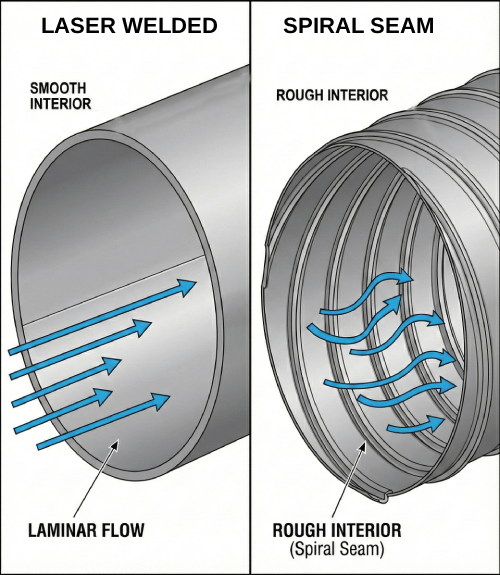
A spiral lock-seam creates a continuous helical ridge running the length of the duct. In pneumatic conveying, this ridge acts as a "speed bump" for air, creating boundary layer turbulence that increases static pressure loss. In contrast, a laser weld is flush with the base metal. It creates a smooth, frictionless internal surface that allows air to move laminarly, reducing the fan’s energy requirement.
A lock-seam is a mechanical fold; metal pressed against metal. Under the vibration of a heavy-duty collector or the pressure of a pulse-cleaning cycle, these folds can loosen, creating long, spiraling leak paths. A laser seam is a metallurgical bond; the metal is fused. It is physically impossible for the seam to leak unless the steel itself is punctured, ensuring 100% containment of fumes and fines.
For food, pharma, and wood applications, the crevices in a lock-seam are "harbor points" where organic material accumulates, rots, or cross-contaminates batches. A laser-welded seam leaves no crevices for bacteria or dust to hide, supporting HACCP compliance and reducing combustion risks from hidden dust pockets.
Laser welding produces a perfectly round cylinder. Spiral forming often results in slight ovalization. In a clamp-together system, perfect roundness is critical for the gasket to seat evenly and seal instantly.