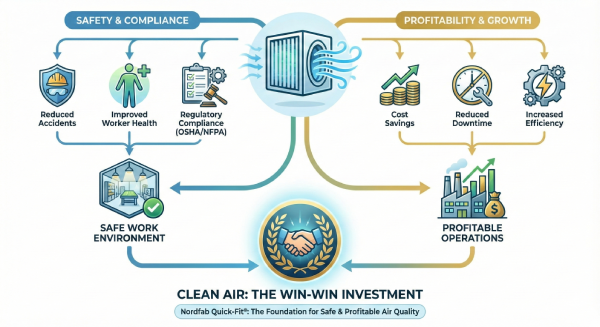
The True Cost of Poor Air Quality in Industrial Spaces: An Engineering & Operational Analysis
Poor industrial air quality is more than a regulatory risk; it is an operational liability that increases energy consumption, equipment failure, and labor costs.
- The Hidden Cost: Inefficient ducting systems can increase fan energy consumption by 33% due to leakage compensation.
- The Operational Impact: Fugitive dust accelerates mechanical wear, causes thermal failure in electronics (PLCs), and creates fire hazards (NFPA compliance risks).
- The Solution: Shifting from static, welded ducting to modular, sealed systems like Nordfab Quick-Fit® turns ventilation into a recoverable asset that improves ROI through lower energy use, faster installation (45-50% time savings), and rapid reconfiguration.
Introduction: Moving Beyond Compliance
In industrial environments, air quality is frequently viewed through the narrow lens of regulatory compliance. Facility managers and engineers often treat dust collection as necessary overhead; systems installed strictly to satisfy OSHA requirements or local fire codes.
However, poor air quality bleeds capital through multiple channels: energy inefficiency, accelerated equipment depreciation, and reduced production agility. When the "cost" of air quality is analyzed holistically, the data suggests that an optimized industrial ventilation system is not merely a safety expense, but a production asset.
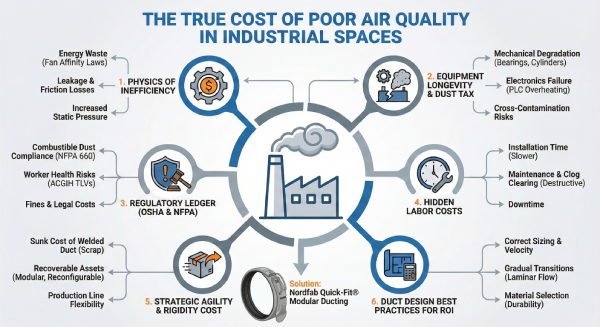
1. The Physics of Inefficiency: Energy and Airflow Performance
The most immediate, quantifiable cost of a poorly designed ventilation system is energy waste. This is governed by the laws of fluid dynamics, specifically the relationship between static pressure, airflow (CFM), and fan brake horsepower (BHP).
The High Cost of Leakage
In traditional flanged or pop-riveted ducting systems, air leakage is a persistent variable. A system with standard leakage rates forces the dust collector’s fan to move more air to maintain the required capture velocity.
- The Fan Affinity Laws: These laws dictate that power consumption increases by the cube of the speed change. If leakage requires you to ramp up fan speed by just 10% to maintain pressure, power consumption increases by approximately 33%. (click here: Understanding The Fan Affinity Laws)
- The Solution: Utilizing modular ducting with robust sealing gaskets, such as Nordfab Quick-Fit®, significantly mitigates leakage. A tighter system allows for the use of Variable Frequency Drives (VFDs) to dial in the exact airflow required without overcompensating for system losses.
Frictional Losses and Static Pressure
High static pressure requires more energy to overcome. Poor duct design contributes to this in two ways:
- Rough Interior Surfaces: Screws, rivets, and interior flanges create turbulence, increasing friction and static pressure. (click here: Friction in Ductwork: The Rough Highway)
- Improper Fittings: Sharp elbows (short centerline radius) or T-junctions introduce shock losses.
From an engineering standpoint, smooth-bore ducting with laser-welded seams reduces the system's total static pressure (SP), allowing for smaller motors or lower fan speeds.
2. Equipment Longevity and the "Dust Tax"
Fugitive dust (particulate that escapes capture due to poor hood design or inadequate transport velocity) settles on infrastructure, creating a "dust tax" on every piece of machinery.
Mechanical Degradation & Thermal Failure
- Abrasive Wear: Dusts like silica and metal grindings migrate into bearings and hydraulic cylinders, creating a grinding paste that accelerates wear and causes premature part replacement.
- Electronics Overheating: Dust accumulation acts as a thermal insulator on heat sinks within control panels and PLCs. This leads to overheating and intermittent electrical faults that are difficult to diagnose. High-efficiency source capture is the only reliable preventive measure for protecting sensitive automation hardware. (click here: The Insulation Effect of Dust)
Cross-Contamination risks
In food processing and pharmaceutical verticals, poor air quality risks cross-contamination. Stainless steel, clamp-together ducting is often specified here for its ability to be easily disassembled and sanitized to ensure product purity.
3. The Regulatory Ledger: OSHA and NFPA Compliance
The cost of non-compliance encompasses legal fees, insurance premiums, and potential shutdowns.
Combustible Dust (NFPA 660)
For facilities handling combustible solids, adherence to NFPA 660 (Standard for Combustible Dusts) is mandatory.
- Dust Accumulation: NFPA standards strictly limit fugitive dust on elevated surfaces. Leaking duct systems require expensive manual cleaning regimes to remain compliant.
- Spark Detection: The modularity of Quick-Fit® enables the easy integration of spark arrestors and isolation valves into existing lines without cutting or welding.
Worker Health (OSHA & ACGIH)
Exceeding ACGIH Threshold Limit Values (TLVs) leads to chronic health issues, resulting in increased healthcare premiums, workers' compensation claims, and the high cost of recruiting skilled labor replacements.
4. The Hidden Labor Costs: Installation and Maintenance
When calculating ROI, labor costs often dwarf material costs.
Installation Time Savings
Traditional installation (cutting, riveting, welding) is a slow, hot-work process.
- The Modularity Advantage: Quick-Fit® clamp-together ducting allows for rapid alignment and installation. Industry estimates consistently show a 45% to 50% reduction in installation time compared to standard flanged ducting, getting production lines back online faster.
Maintenance and Clogs
Clearing a clog in a riveted system is destructive and time-consuming. A clamped system allows maintenance personnel to unclamp the affected section, remove the obstruction, and re-clamp it in minutes without tools.
5. Strategic Agility: The Cost of Rigidity
In the current manufacturing landscape, flexibility is a competitive advantage.
- The "Sunk Cost" of Welded Duct: When a line moves, traditional welded ducting is difficult to dismantle and often scrapped, representing a total loss of capital investment.
- Recoverable Assets: Modular ducting is reconfigurable. If a machine moves, the ducting can be unclamped, adjusted with telescoping sleeves, and reconnected. The ducting becomes a transferable asset rather than a sunk building cost.
6. Duct Design Best Practices for ROI
To minimize costs, engineers should adhere to specific design principles:
- Correct Sizing: Calculate the required Transport Velocity (typically 3,500–4,500 FPM for heavy dusts) to prevent material drop-out and blockages. (Note: Minimum Transport Velocity (MTV) varies by material density. Light fibrous materials (lint) may require only 2,500 fpm, while heavy industrial dusts often require 3,500–4,500 fpm. Always calculate based on your specific material.)
- Gradual Transitions: Use tapered reducers and ensure branch entries enter the main trunk at 30 or 45 degrees to maintain laminar flow.
- Material Selection: Match material to the application; Galvanized Steel for general dust, Stainless Steel for food/corrosive environments, and Heavy Gauge for abrasive materials.
Conclusion: Investing in Performance
The true cost of poor air quality is found in the margins: increased energy bills, lost machine availability, and manual cleaning labor. Treating industrial ventilation as a high-performance system utilizing aerodynamically efficient, modular solutions like Nordfab Quick-Fit® allows facilities to achieve stricter compliance while driving down operational costs.
Next Steps for Facility Stakeholders:
- Conduct a Pressure Audit: Measure static pressure at the hood and fan inlet to identify blockages or poor design.
- Inspect for Leakage: Identify areas where dust is visible on the exterior of ductwork.
- Evaluate Flexibility: Determine if your current infrastructure allows for the rapid relocation of machinery.
Clean air is not just safe, it is profitable.
Request a project review with a Nordfab Ducting Specialist.