
In textile lint extraction, intuitive "fixes" often run counter to the laws of fluid dynamics. When designing or troubleshooting a system, it is critical to separate common misconceptions from engineering reality to ensure long-term performance and compliance with ASHRAE 90.1 and NFPA 660.
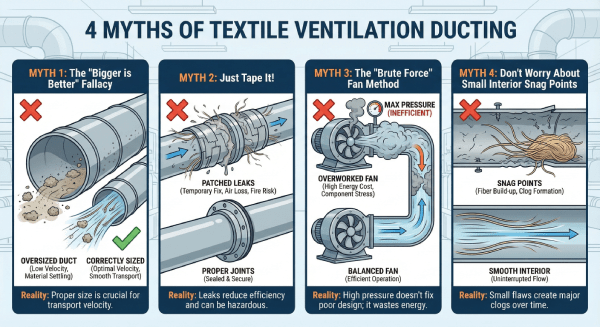
Installing a larger diameter duct will reduce friction and allow the system to "breathe" better, preventing clogs.
In a pneumatic conveying system, velocity is the priority, not just volume. Airflow (Q) and velocity (V) are related by the cross-sectional area (A) of the duct:
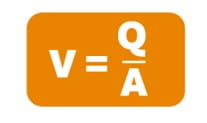
Minimum Transport Velocity (MTV) of approximately 2,500 fpm, the fibers will lose buoyancy and settle. This creates a "snowdrift" effect inside the pipe, which ironically reduces the effective area and increases static pressure, eventually choking the system entirely.
Using duct tape or industrial sealants on leaky joints is a cost-effective way to maintain system pressure.
Textile extraction systems are subject to constant vibration from high-horsepower fans and thermal cycling from conditioned plant air. Over time, pressure-sensitive adhesives dry out and peel, or "blow out" under the positive or negative pressure of the system.
Furthermore, ASHRAE 90.1 (Section 6.4.4) requires permanent, verifiable sealing. A leak is not just a loss of air; it is a loss of transport energy. For every 10% of air lost to leakage, there is a corresponding drop in velocity downstream. Precision-engineered modular systems, such as Quick-Fit®, utilize mechanical gaskets and rolled-edge clamps that provide a consistent, airtight seal capable of withstanding industrial rigors without the degradation seen in temporary fixes.
If the system is clogging, simply increasing the fan speed via the Variable Frequency Drive (VFD) will "blow out" the obstruction and solve the problem.
While increasing fan speed will increase velocity, it does so at a massive energy penalty. According to the Fan Laws, the power required (P) increases by the cube of the speed ratio:
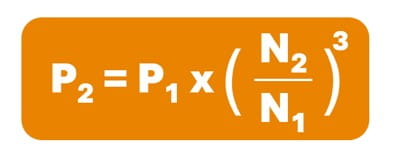
If you increase fan speed by just 10% to overcome a clog, your energy consumption increases by 33%. Furthermore, "brute-forcing" a system often forces lint into the filter media at higher velocities, causing "blinding" (deep-seated clogging of the filters) and increasing the risk of static-generated sparks, which poses a fire hazard under NFPA 660. The sustainable solution is to eliminate the source of resistance—the clog—by using smooth-walled, properly sized ducting.
Small burrs, screws, or slight misalignments at duct joints are negligible in high-speed airflow.
Textile lint is uniquely fibrous and "sticky." A single protruding screw or a "lip" caused by a misaligned flanged joint acts as an anchor. Once a few fibers snag, they catch others, leading to a "bolus" or ball of lint that grows until it blocks the pipe.
This is why modular, clamp-together ducting is the industry standard for "fluff" applications; the rolled edges ensure the sections are perfectly concentric, and the absence of internal fasteners removes the primary catalysts for clog formation.