Choosing the right type of ducting doesn’t have to be complicated
In industrial environments, clean air isn’t just a comfort – it’s a necessity. Whether you’re dealing with dust, fumes, oil, or mist, the performance of your process ventilation system depends heavily on the quality and type of ducting. The wrong ducting system leads to inefficiency, increased costs, and even safety risks.
Seamless strength: The advantage of laser-welded ducting
Laser-welded ducting is a type of ductwork manufactured with precision laser welding technology. After a metal blank is rolled into a cylindrical shape, a high-powered laser beam is directed along the seam where the metal edges meet. The laser melts the edges, which then fuse together as they cool, forming a continuous weld. The result is a seamless, leak-tight, and structurally robust duct suitable for higher-pressure and demanding environments. The smooth interior of laser-welded ducting is a crucial advantage for such applications as timber, textile, or recycling industries, as this type of ductwork enhances safety. With no seams or crevices for dust to accumulate, laser-welded ducting eliminates the risk of debris build-up and blockages — significantly reducing the potential for fires or explosions, and ensuring continuous, reliable operation.
The hidden risks of spiral lock-form ducting
The most common type of spiral (spiro) ducting is lock-formed. Lock-formed ducts are made from spiralled strips of metal mechanically locked together. Such connections, also referred to as crushed seams, can create a slight ridge or indentation along the spiral, which can be a point of concern for air leakage and dust accumulation. While cost-effective, this method also requires more maintenance due to its seam and connections structure. Spiral lock-form ducting differs significantly from laser-welded ductwork: its installation requires screws and joiners that pierce the duct and protrude into the airflow, creating catch points for the dust and mist going through the system. As a result, spiral lock-form ducting can trap debris and cause potential blockages, reducing system efficiency and compromising safety in certain industrial applications. Frequent blockages increase maintenance costs and potentially lead to ignitions, fires, or explosions, as debris can be ignited
by sparks.
Five key advantages of Quick-Fit (QF) laser-welded ducting system
- Safe and reliable.
Smooth crevice-free interiors that minimise the risk of dust build-up, fires, and explosions. Perfect for demanding industries such as textile, woodwork, and recycle.
- Fast and reliable installation and maintenance.
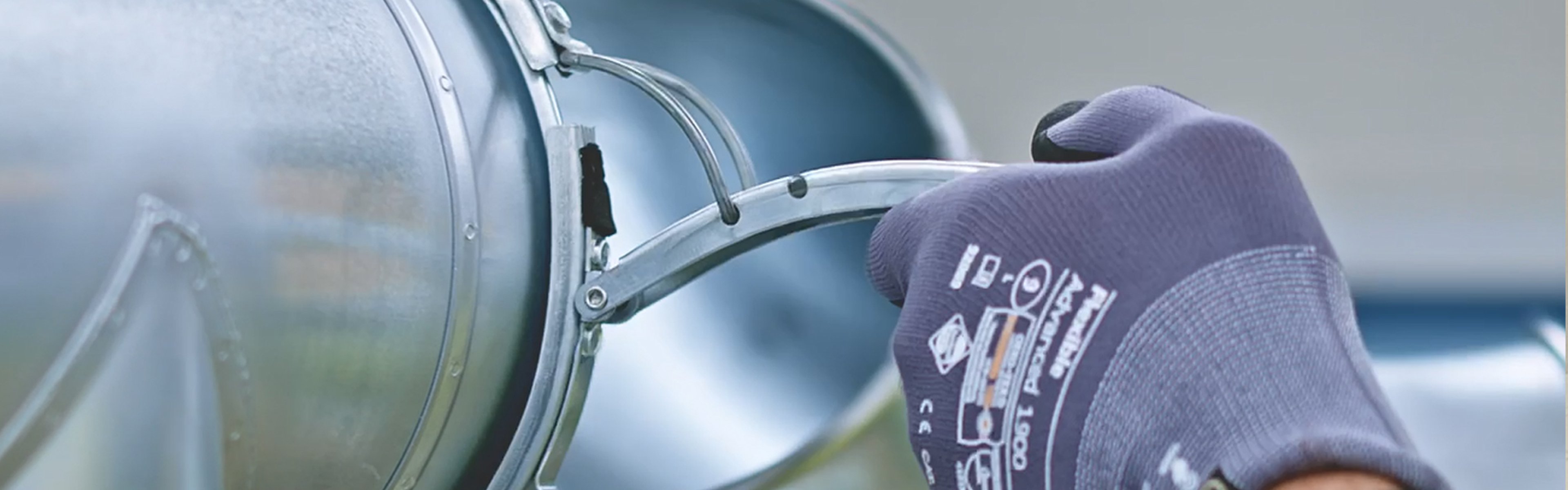
This modular ducting system clamp together in seconds without welds, bolts, screws, special tools, precise measurements, or specialised skills needed. It cuts installation time by more than 45% compared to traditional ductwork.
- Energy efficient and durable.
It minimises air leakage and pressure loss throughout the system and meets the highest air-tightness standards, ensuring stable airflow, maximum performance, and improved energy efficiency – all of which help reduce operating costs. Its leak-tight seams also lower the risk of corrosion and contamination, allowing system components to last for many years.
- Sustainable and low-waste.
Maintains its shape and strength after multiple installation cycles without deformation or leaks. It is feasible to reinstall or relocate Quick-Fit (QF) ducting components many times, ensuring one of the lowest life cycle costs on the market.
- Easy to use in specifications.
Accuracy matters in design. Nordfab provides comprehensive digital resources such Revit models, DWG, and STP files. This makes it easy to integrate Quick-Fit (QF) laser-welded ducting
system into engineering workflows, ensuring precise specifications and reducing costly design errors.
When the difference matters
In non-critical environments, spiral lock-form ducting may be an acceptable compromise; it is often sufficient for ventilation and air conditioning in office buildings, retail spaces, or community centres. However, it is not recommended for higher-vacuum environments, areas with strict hygiene requirements, or mist and dust applications, as spiral lock-form ducting is more prone to blockages and dust build-up, increasing fire and explosion risk. Nordfab’s Quick-Fit (QF) laser-welded ducting is particularly valuable in applications where durability, cleanliness, and safety are essential – such as
in laboratories, and pharmaceuticals, timber and textile industries, or food and recycling applications. In industries where even minor faults can lead to inefficiencies, contamination risks, or increased
operational costs, laser-welded ducting is the best choice.
The ABC for selecting the right ductwork for process ventilation
Assess the risks.
Process ventilation may be advanced, and the wrong ducting can compromise safety and efficiency. Spiral lock-form ducting has seams, screws, and joints that create catch points for dust and mist. These buildup zones lead to blockages, reduced airflow, and even ignition hazards — especially in industries like timber, textiles, and recycling.
Beware of spiral lock-form limitations.
Lock-formed spiral ducts are cost-effective for non-critical environments like offices or retail spaces. However, in higher-vacuum or dust-heavy applications, they pose serious risks. Uneven seams
trap debris, increase maintenance costs, and can lead to fires or explosions. Spiral lock-form ducting also requires tools and skilled labour for installation, adding complexity and downtime.
Choose laser-welded ducting for safety and speed.
Laser-welded ducting offers a smooth, seamless interior that prevents dust accumulation and ensures leak-tight performance. It’s ideal for demanding environments where cleanliness, durability, and
safety are essential. With Quick-Fit (QF) technology, installation is tool-free and fast — making reconfiguration simple and reducing downtime. Plus, its robust design supports sustainability through
reuse without performance loss.