
At first glance, installing flanged ducting seems foolproof: line up the holes, insert bolts, and tighten. In reality, it is one of the most difficult connection methods to execute correctly in a field environment.
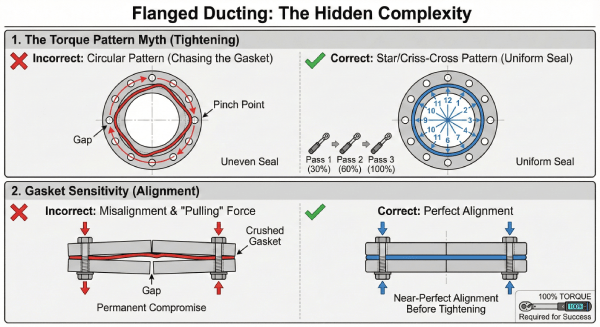
Many installers instinctively tighten bolts in a circle (12 o’clock, 1 o’clock, 2 o’clock). This "chases" the gasket material around the ring, creating a pinch point on one side and a gap on the other.
To achieve a uniform seal, bolts must be tightened in a specific "star" or criss-cross pattern (e.g., 12-6, 3-9, etc.) and in multiple passes (30%, 60%, 100% torque).
This requires discipline and time that are rarely available in rushed shutdowns.
Furthermore, Gasket Sensitivity is unforgiving. If flanges are slightly misaligned, common in complex industrial layouts, installers often use the bolts to "pull" the ductwork together.
This uneven force crushes the gasket on one side before the seal is formed, permanently compromising the joint.
Unlike clamp-together systems that allow for slight rotational and angular adjustments, a flange demands near-perfect alignment before the first bolt is even threaded.
Ultimately, a flange is only as good as the person installing it. Without a calibrated torque wrench and a strict sequence, even a brand-new flanged system is likely to leak from day one.
It looks like you're coming from United States.
Would you like to go to the United States site?